Poll: More than a third of American voters don't trust U.S. power grid
National News

Audio By Carbonatix
10:59 AM on Friday, March 20
Andrew Rice
(The Center Square) - Slightly more than half of American voters say they at least "somewhat trust" the American power grid, according to a new poll.

The Center Square Voters' Voice Poll - Logo - White Background
The Center Square Voters’ Voice Poll found that 55% of American voters said they completely or somewhat trust the American power grid. When that figure is broken down, 42% of voters said they only “somewhat trust” the power grid and 13% of voters said they “completely trust” the power grid. But 37% of voters say they don't trust the grid, including 13% who "completely distrust" it.
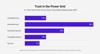
TCS VVP Mar 2026 - Trust in Power Grid
Data: The Center Square Voters’ Voice Poll (March 2026) Chart: Kate Guenther / The Center Square
The Center Square Voters’ Voice Poll was conducted by Noble Predictive Insights between March 2-5, 2026. The poll sample included 2,659 registered voters, comprising 1,177 Republicans, 1,270 Democrats, and 773 Independents, of which 330 do not lean toward either major party. The tracking poll is among the most comprehensive in the country.
Across partisan lines, Republican respondents had a greater overall level of trust in the U.S. power grid. About 66% of Republicans said they at least “somewhat trust” the U.S. power grid whereas only 45% of Democrats said the same.
However, 45% of Democrat respondents said they either somewhat or completely distrust the power grid.
Mike Noble, founder of Noble Predictive Insights, said this issue reflects general lack of trust in institutions across the country. He said independent voters are stuck between Republicans and Democrats in the midst of this increasing distrust.
Only 34% of independents respondents who do not lean toward either major party at least “somewhat trust” the power grid. About 20% of those independents said they “completely distrust” the U.S. power grid and 30% "somewhat trust the grid.
“There’s just overall lower confidence in general, and they have shaky confidence with it,” Noble said. “People just don’t really trust institutions or things that have just been around for a long time that have been really reliable.”
The U.S. Department of Energy has stressed the importance of greater reliance on the domestic power grid, especially as companies continue investing in artificial intelligence data centers. The department projected a 100 times increase in risk by 2030 if grid facilities continue to retire at the current rate.
The Energy Department’s models predicted as much as 800 outage hours per year. Recent winter storms have led Energy Secretary Chris Wright to call on grid operators to use backup generation resources at data centers across the country.
"President Trump and the Energy Department remain committed to doing everything in our power to mitigate blackouts and lower energy costs for the American people," Wright said.
Power outages cost Americans roughly $44 billion per year, according to data from the DOE’s national laboratories.
Respondents with more education reported fewer concerns about the country’s power grid. About 59% of respondents with college degrees said they at least “somewhat trust” the power grid whereas 49% of respondents with some college experience said the same. About 63% of respondents with post-graduate degrees at least somewhat trust the grid.
Black and Hispanic or Latino respondents had the highest levels of distrust in the power grid. About 17% of Black respondents said they "completely distrust” the power grid and 19% of Hispanic or Latinos said the same.
About 14% of Black respondents "completely trust" the power grid and 16% of Hispanics or Latinos said the same.
“There’s this degradation in institutions and structures,” Noble said. “A decade or so ago, were any of your parents ever talking about, ‘Oh, how is the power grid doing?’ It just seems now there is more distrust.”